Showing posts with label Parent Education. Show all posts

Thursday, April 21, 2016

SELPA1:  Monthly "Let's Talk" Event


Wellness Focused for Teens


By Kyle Yamasaki, MFT, Site Supervisor for Redwood Continuation High School 
Wellness has been around for millennia but it feels like a refreshing approach to helping teens with social-emotional problems in our schools.  As the site supervisor at Redwood Continuation High School (RHS) in the Sequoia Union High School District (SUHSD), I can share some of the exciting wellness activities organized by the ACS on-campus counseling team and SUHSD.  But first, what is “Wellness” in this context?
The World Health Organization defines wellness as “the optimal state of health of individuals and groups.  There are two focal concerns, the realization of the fullest potential of an individual physically, psychologically, socially, spiritually, and economically, and the fulfilment of one’s role expectations in the family, community, place of worship, workplace and other settings.”
Pertinent to the teens we work with, research supports that the focus on mental wellness can help with with self-regulation of intense emotions, resilience to stressors, and recovery from crises or illness, for example.  For example, at RHS, although the ACS team often addresses mental wellness issues with referred students who have urgent needs, but we are also more concerned about the presence of wellness for those who do not see us.  The absence of distress does not indicate a presence of wellness.  
Teens come to RHS for extreme deficiency in credits which appears to be symptom of other major stressors.  Most of which are coped with in unhealthy, but peer approved ways such as avoiding school, avoiding family, or self-medicating.  This is in addition to the basic stresses of adolescence.
RHS teachers and administrators, and the ACS team see significant potential in each student. We know this from the students we work with.  Students display resilience against seemingly overwhelming odds.  I discussed these concerns with the ACS interns who suggested ideas to engage students in wellness activities.   
We started with learning more about the students we worked with.  We found that both male and female RHS students overwhelmingly wanted lunch time sport related activities, learn more about cooking and healthy eating, and expressed interest in therapeutic art activities.  
In kind, ACS has started to work on providing activities like this during lunchtime.  So far, we have successfully engaged a small group of adolescent boys in a mural activity and creating spirit stones, for example.  A new social work intern has also recently joined our team who will start to engage the adolescent boys for lunchtime sports activities.  
As a site supervisor at RHS, what has also been remarkable to me is seeing how the ACS interns have also been able to share their passions and talents that match our students.  It seems like a natural synergy that is more meaningful and healthy for everyone.
While ACS’s efforts are just starting, SUHSD has been committed to some innovative wellness activities.  Most notably is RHS’s meditation-based stress reduction and wellness program called Quiet Time, an evidenced based program that has reported outcomes such as improved GPA, increased attendance, and reduced anxiety and psychological distress.  
The core activity of Quiet Time is transcendental meditation that the students, teachers, and administrators all participate in.  On campus in select classrooms, doors are closed with a “meditation in progress” sign.  For 20 minutes, two times a day, students meditate.  Students rave about the positive impacts this has had on their lives.  Students who were having a bad day even came into our ACS office at RHS, needing some space to meditate.
What is most promising for Wellness in our high schools is the effort to help everyone achieve their highest potential and level of functioning.  It is be exciting to see what other new wellness programs will be initiated at different high schools, especially as wellness policies at PAUSD and SUHSD continue to be implemented.
References:
Manderscheid RW, Ryff CD, Freeman EJ, McKnight-Eily LR, Dhingra S, Strine TW. Evolving 
definitions of mental illness and wellness.Prev Chronic Dis 2010;7(1):A19. 

Adolescent Counseling Services is a community non-profit, which provides vital counseling services on nine secondary campuses at no charge to students and their families. To learn more about our services please visit the ACS website at www.acs-teens.org. ACS relies on the generosity of community members to continue offering individual, family, and group counseling to over 1,500 individuals annually. ACS provides critical interventions and mental health services, building a better future for tomorrow. If you are interested in helping to support our efforts, do not hesitate to call to make a donation. It goes a long way in helping teenagers find their way!

Thursday, April 14, 2016

Parent Ed:  Parenting Teens for Success: A Panel Discussion

(Note: Chinese, Korean, and Spanish translations of this flyer follow below)
To reserve a seat, register at http://lythcott.eventbrite.com

(青少年迈向成功的教养之道)

(Julie Lythcott-Haims 主持嘉宾座谈讨论时间)

(“如何养育一个成年人:冲破过度教养的陷阱与帮助你的孩子迈向成功做出准备”)
(
(请加入我们来进行一场即席生动的讨论,讨论主题是《抛弃“一切在计划清单下的童年”观念的好处, 以及教导青少年生活上技能和自我满足感)
(星期四,4月28日) . (晚上7点到9点)
(地点)  (Spangenberg大礼堂)  Gunn High School (Gunn高中
 
(讲演者)
(Julie Lythcott-Haims是纽约时报畅销书作家,史丹佛大学的前任大一新生系主任,同时也是GUNN高中的学生家长。她也曾经受邀在TEDx中演说,在Huffington邮报)
里受邀投稿。目前在California College of Arts学校攻读写作专业的艺术硕士学位。
 
(受邀参与座谈讲座的嘉宾)
  • Julie Lytheott-Haims, 主持人
  • Carlos Gonzalez, GUNN高中·学生·家长
  • Dr. Hoai-Thu Truong博士,临床心理学家)
  • Roni Habib, GUNN高中
  • Chloe Sorensen正向心理学教师, GUNN高中高三学生家长主席)

​ 를  쓴 작가, Julie Lythcott­-Haims가 주최하는 공개 토론회 “checklisted childhood”라는 관념버림의 해택 그리고 teen들의 생활기술과 자급자족에 대해  이야기하는 생동감 있는 공개 토론회에 참석하세요. 
   
  날짜:  목요일, 4월 28일 7~9 PM     장소:  Spangenberg Theatre Gunn H,       이 행사는 무료입니다.  자리예약은 여기서 하세요. http://lythcott.eventbrite.com

 키노트 발표자    Julie Lythcott­Haims는  베스튼셀러 작가이며, 에서   이었고, Gunn High School에 다니는 학생의 부모이다. 그녀는 에서 섰던  연설자였고, 를 기고하며, 지금은 에서  글쓰기를 추구하고있다.    토론자 명단  
  • Julie Lythcott­Haims, 사회자  
  • Carlos Gonzalez,  부모  
  • Dr. Hoai-­Thu Truong, 임상 심리학자 
  • Roni Habib,  긍정 심리학 교사  
  • Chloe Sorensen, 학년 회장    질문은 토론중 또는 키노트가 끝나고 할수있음니다


Padres de adolescentes para el exito
Una mesa redonda moderada por Julie Lythcott - Haims Autora de Cómo criar a un adulto:  Rompiendo  la  trampa de la sobreprotección y como preparar a su niño para el éxito.
Por favor Acompáñenos en una animada discusión sobre los beneficios de dejar atrás la infancia y enseñar a los adolecentes  las habilidades para ser auto suficientes.
Cuándo: Jueves Abril  28.  7-9 PM
Donde: Spangenberg Teatro en  Gunn  High School 780 Arrastradero Road Palo Alto.
R.S.V.P Entrada libre, para reservar por  favor registrarse en  http://lythcott.eventbrite.com

Panelistas:
  • Julie Lythcott - Haims , moderador
  • Carlos González, Gunn HS padre. (representante de la comunidad hispana)
  • Dr. Hoai-Thu Truong , psicólogo clínico
  • Roni Habib, profesor de la psicología positiva en Gunn HS,
  • Chloe Sorensen, Gunn HS Estudiante Clase Joven Presidente.


Thursday, March 31, 2016

SELPA1 - Parent Education: Parent Fatigue/Stress


Wednesday, March 30, 2016


SELPA1:  Monthly "Let's Talk" Parent Ed


Thursday, February 25, 2016

Thursday, January 28, 2016

SELPA1:  Monthly "Let's Talk" Event


Thursday, January 21, 2016

Parent Ed:  Alcohol & Drug Education Workshop for Parents


Friday, January 15, 2016

ACS:  Understanding and Coping with Anxiety

By Deborah Sloss, LCSW

Most of us have experienced anxiety at some point in our lives. Some people even feel a moderate amount of anxiety spurs them to action.  However, for others, anxiety can start to interfere with their day-to-day functioning.  According to the National Institute of Mental Health, anxiety disorders are among the most common mental disorders experienced by Americans; as many as 25% of teens and adults will experience some form of significant anxiety during their lifetimes. While anxiety is a normal reaction to stress, when anxiety becomes overwhelming, it can be debilitating and affect general well-being, social life, academic performance and social interactions.  And while the person suffering may realize their worry is excessive, they may also have difficulty controlling it.  For example, a person may avoid situations that cause anxiety or suffer through them with little enjoyment and lots of distress. If anxiety is interfering with your day-to-day life, there are steps you can take to reset this balance.  Understanding more about anxiety itself and learning ways to identify the anxious components in your own thoughts, feelings and behavior can lead to effective ways to cope and manage anxiety.
Three Components of Anxiety
There are three major components of anxiety: physical sensations, thoughts (cognitions) and behaviors.

  • The physical sensations of anxiety may include feeling wound-up, tense or restless, fatigue, difficulty concentrating, irritability, muscle tension, difficulty with sleep, and stomach pains. In more severe cases, panic attacks may result in heart palpitations, shortness of breath, lightheadedness, nausea, sweating, shaking, a choking feeling, chest pain, chills, and numbness.
  • Anxious thoughts (also called cognitions) can be about suspected danger, fear of dying, fear of losing control, and worry about having additional panic attacks.  For example, one might fear that chest pains caused by anxiety are a deadly heart attack or that the shooting pains in one’s head are the result of a tumor or aneurysm. One might have intense and recurrent thoughts of dying.  Anxious thoughts may also result in nightmares or bad dreams, and feeling like everything is scary.
  • Anxious behaviors might include: reduced eye contact, nail biting and other nervous habits, or an increase in motor activities, like foot tapping. One may also avoid situations or withdraw from activities that previously caused discomfort.
It is important to note that “…when a person becomes anxious, the cognitive, physical, and behavioral components of anxiety interact with each other…For example, an anxious thought may lead to increased heart rate and muscle tension, which in turns leads to more anxious thoughts” (Hope, Heimburg and Turk, 29-30).
What can we do to manage anxiety?
While there are a number of methods that have proven helpful in addressing the physical component of anxiety, this article will focus on Cognitive Behavioral Therapy (CBT), a research-based technique that helps manage the thoughts and behavior generated by anxiety. CBT was developed in the mid 1950s and early 1960s by Drs. Albert Ellis and Aaron Beck.  CBT therapists realized that understanding the interaction between thoughts, feelings and events is the first step in successfully managing anxiety. These ideas were later expanded on by Dr. David Burns. In his book, Feeling Good, The New Mood Therapy, Burns explains that our interpretation of events is often governed by negative or “automatic” thoughts, which can result in anxiety. Here are some examples of automatic, negative and anxious thoughts that may sound familiar: 

  • I’m going to fail this test
  • I will never get into a good college
  • All of the kids at school think I’m a loser
Talking Back to Automatic Thoughts
It can take time to figure out how one’s thoughts are tilted toward the negative.  Once we can do that, we can start “talking back” to our thoughts and we are on the way to feeling less anxious.  Dr. Burns says, quite simply and powerfully, that by changing the way we think, we can change the way we feel (Burns, 29). One example of a more balanced, less negative thought to “talk back” to anxiety might look like this:

  • I’m afraid I am going to fail this test and so sometimes I want to throw my hands up and not study.
Here the student is acknowledging where her anxiety is coming from.

  • But, I’m kind of ignoring the positives here.
This is identifying how this thought might be distorted.

  • I actually have studied all week and kind of know what I am talking about!
This is a more balanced thought about the situation, with some hope added in.
By stepping back and looking at her automatic thoughts more objectively, the student was able to create a shift in her thinking. By substituting a more positive and realistic thought for the negative one, she is on the road to changing how she feels.
Summary
Anxiety is something we all deal with.  This article focuses on the cognitive aspect of anxiety.  When we find ourselves feeling anxious or upset, it is important to tune into our feelings and identify negative or automatic thoughts that accompany these feelings. Can we take a step back and ask ourselves if there is another way to look at the situation?  If we can substitute realistic, positive thoughts for negative ones, then we are on our way to managing anxiety.
Resources
Feeling Good, The New Mood Therapy, Dr. David Burns

Adolescent Counseling Services is a community non-profit, which provides vital counseling services on nine secondary campuses at no charge to students and their families. To learn more about our services please visit the ACS website at www.acs-teens.org. ACS relies on the generosity of community members to continue offering individual, family, and group counseling to over 1,500 individuals annually. ACS provides critical interventions and mental health services, building a better future for tomorrow. If you are interested in helping to support our efforts, do not hesitate to call to make a donation. It goes a long way in helping teenagers find their way!

SELPA1: Learning Challenges Resource Fair


Thursday, December 17, 2015

Thursday, October 29, 2015

SELPA 1:  Alternative Pathways Through High School


Thursday, September 24, 2015

Not In Our School Week - 9/28-10/2

Movie Nights at Gunn's Spangenberg Theatre!
Two screenings on Gender Stereotyping.  FREE and open to all community members, Gunn parents, students, family and friends
Miss Representation - Tuesday 9/29 6-8pm
A special screening of the award winning documentary film, Miss Representation, is a documentary film focuses on gender stereotyping of females and the negative effects this can have on adolescents and teens.  
The Mask You Live In - Wednesday 9/30 6-8pm
The Mask You Live In, a documentary film premiering at the 2015 Sundance Film Festival, asks the important question: Is American masculinity harming our boys, young men and society at large? Compared to girls, research shows that boys in the U.S. are more likely to be diagnosed with a behavior disorder, prescribed stimulant medications (for ADD/ADHD), fail out of school, binge drink, commit a violent crime, and/or take their own lives. 


SELPA 1 CAC Parent Ed Night:

Suicide Prevention and Grieving - Presented by Charlotte Ross Fisher, who was the founding CEO at the Suicide Prevention & Crisis Center of San Mateo County for over 22 years and was Executive Director of Youth Suicide National Center in Washington, DC.
Wednesday, October 21, 2015, 7 to 9 pm
Covington Elementary School Multipurpose Room
205 Covington, Los Altos 94024  
For more information, see www.selpa1cac.org

Prevención del Suicidio y Duelo - Presentado por Charlotte Ross Fisher, que era el consejero delegado y fundador de la prevención del suicidio y Centro de Crisis del Condado de San Mateo por más de 22 años y fue Director Ejecutivo del Suicidio Juvenil Centro Nacional en Washington, DC.  Será presentado en Inglés.
Miércoles, 21 Octubre  2015, 7 - 9 pm 
en la Escuela Primaria Covington Multi
205 Covington, Los Altos, 94024
Para más información, consulte www.selpa1cac.org

Friday, September 18, 2015

PAUSD Parent Ed Event:  Supporting Your Child During the High School Transition


Thursday, September 10, 2015


Parent Education Evening

Sponsored by the SELPA 1 CAC (www.selpa1cac.org)  All of our events are free and open to anyone who feels they might benefit.  No registration is necessary.

Thursday, May 14, 2015

SELPA 1 CAC Parent Ed

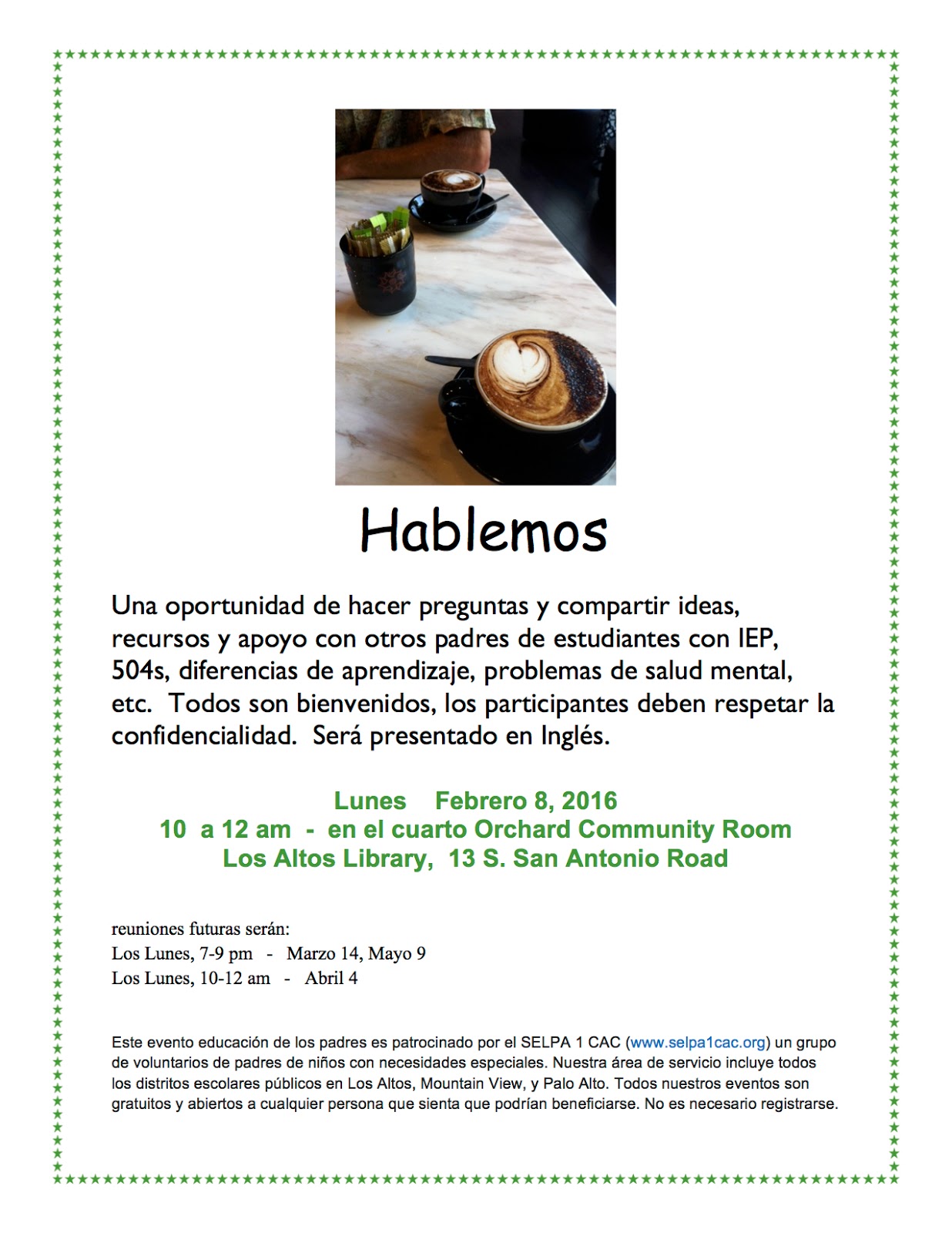
Let's Talk - A chance to ask questions and share ideas, resources, and support with other parents of students with IEPs, 504s, learning differences, mental health challenges, etc.  All are welcome, participants must respect confidentiality.  
Monday June 8, 2015, 7 pm to 9 pm - In the community room of Los Altos Library on San Antonio Road.  Mark your calendars - future meetings will be:  Monday July 13, 10 am to 12 noon, and Monday August 10, 7pm to 9 pm.
Hablemos - Una oportunidad de hacer preguntas y compartir ideas, recursos y apoyo con otros padres de estudiantes con IEP, 504s, diferencias de aprendizaje, problemas de salud mental, etc.Todos son bienvenidos, los participantes deben respetar la confidencialidad.  Será presentado en Inglés.
Lunes 8 Junio, 2015, de 7 pm a 9 pm - en la sala de la comunidad de Los Altos Biblioteca en San Antonio Road.  
For more information see (Para más información) consulte www.selpa1cac.org

This parent education event is sponsored by the SELPA 1 CAC (www.selpa1cac.org) an all-volunteer group of parents of children with special needs.  Our service area includes all public school districts in Los Altos, Mountain View, and Palo Alto.  All of our events are free and open to anyone who feels they might benefit.  No registration is necessary

Thursday, March 26, 2015

Not In Our Schools Week - Gunn Presents The Mask You Live In

The Mask You Live In follows boys and young men as they struggle to stay true to themselves while negotiating America’s narrow definition of masculinity.
Pressured by the media, their peer group, and even the adults in their lives, the protagonists confront messages encouraging them to disconnect from their emotions, devalue authentic friendships, objectify and degrade women, and resolve conflicts through violence. These gender stereotypes interconnect with race, class, and circumstance, creating a maze of identity issues boys and young men must navigate to become “real” men.
Experts in neuroscience, psychology, sociology, sports, education, and media also weigh in, offering empirical evidence of the “boy crisis” and tactics to combat it. The Mask You Live In ultimately illustrates how we, as a society, can raise a healthier generation of boys and young men.
Join us for this screening April 16th at 6PM, which will be followed by a moderated discussion by Dr. Jerrold Shapiro.  This film is not rated and contains sensitive topics; we recommend the attendance to be upperclassmen and adults only. (View the trailer here)
Admission is free, though we encourage attendees to bring a donation of canned food that will benefit a local food bank. Reserve your tickets on eventbrite.